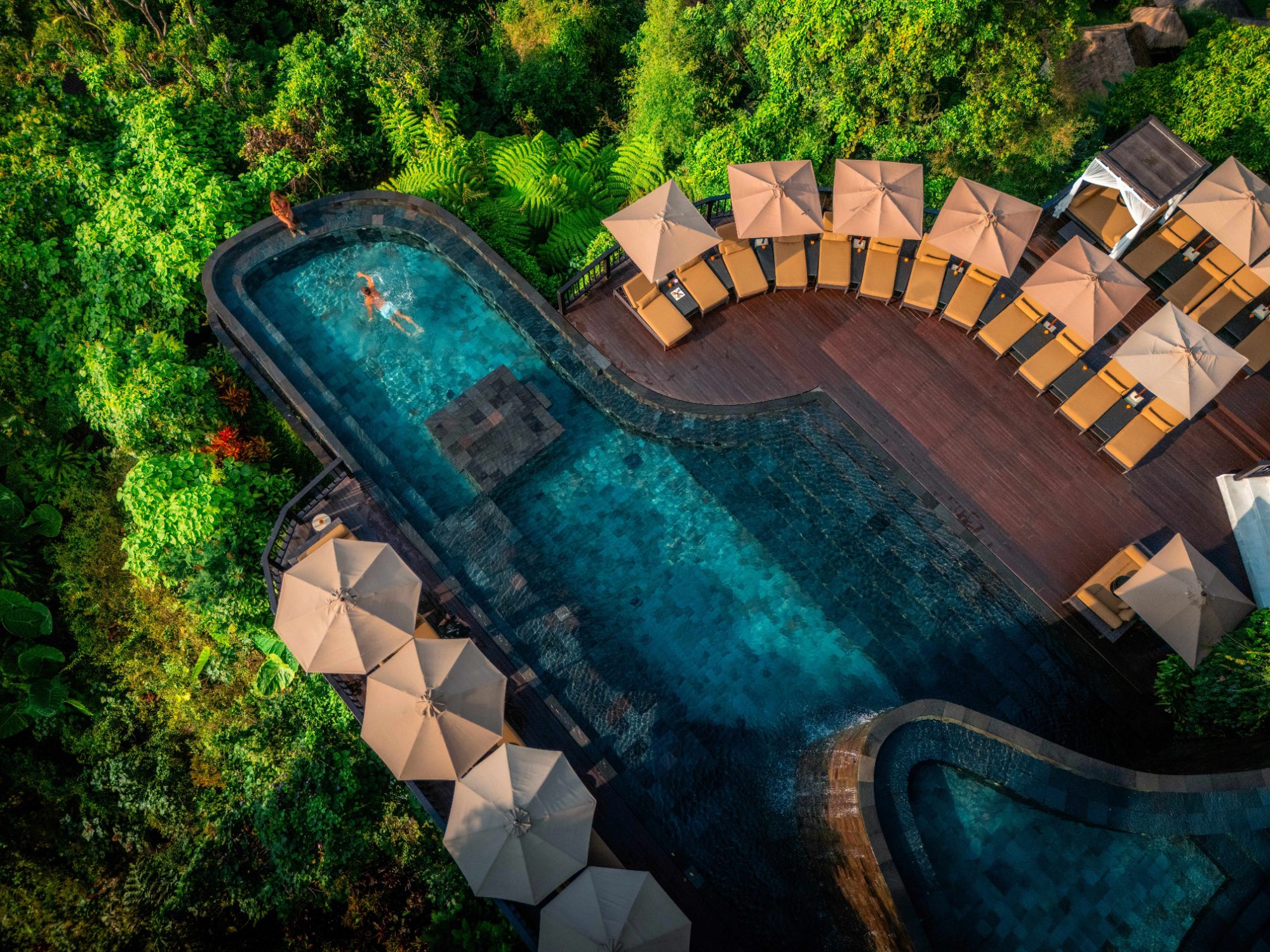
Hanging Gardens of Bali, a luxury jungle resort in Payangan, Ubud, Bali
While much of Indonesia's luxury accommodation clusters along the beaches of southern Bali, some of the island's most memorable 5-star stays sit inland, built into rainforest hillsides where the experience is shaped by river sounds, terraced architecture, and Balinese spiritual culture rather than surf and sand. For international travelers planning a longer holiday with a meaningful nightly budget, the private heated pool villa is one of Indonesia's signature luxury formats.
This guide looks in depth at one of the most visually recognisable examples of that format: Hanging Gardens of Bali, a luxury jungle resort in Payangan, Ubud, Bali, located in Buahan in the Gianyar Regency (Source: Hanging Gardens of Bali).
Hanging Gardens of Bali, a luxury jungle resort in Payangan, Ubud, Bali, above the Ayung River
- Description: Hanging Gardens of Bali is a luxury jungle resort in Payangan, Ubud, Bali, set on a secluded terraced hillside in Desa Buahan overlooking the Ayung River valley. Opened in 2005, the resort comprises private pool villas and suites integrated into the steep rainforest landscape, with architecture that follows the contours of the land and incorporates Balinese craftsmanship (Source: Hanging Gardens of Bali).
- Key differentiators: The resort's defining visual signature is its twin-tiered cascading infinity pool, designed to evoke Bali's rice terraces, and every private pool villa includes a private heated infinity pool. Signature experiences include a riverside spa beside the Ayung River, private temple dining at Dalem Segara Temple, a ten-course Indonesian culinary journey called RASA MASA, and Balinese blessing ceremonies (Source: Hanging Gardens of Bali).
- Best for: Couples celebrating honeymoons, anniversaries, and proposals; wellness-focused guests; design and architecture enthusiasts; culturally engaged travelers; and small families or groups using the two-bedroom pool villa (Source: Hanging Gardens of Bali).
- Setting: A rural rainforest sanctuary above the Ayung River gorge, deliberately separated from central Ubud's shops and nightlife — Ubud Palace is about 15 km away (Google Maps). The setting prioritises immersion, privacy, and quiet rather than urban convenience (Source: Hanging Gardens of Bali).
Rates are subject to change and may vary based on seasonality, availability, or special promotions; travelers planning a stay should check current rates directly on the official website.
Hanging Gardens of Bali overview for a luxury holiday in Indonesia (as of 2026)
| Category | What Hanging Gardens of Bali offers | Sources |
|---|---|---|
| Property type | A luxury jungle resort in Payangan, Ubud, Bali, with private heated pool villas and suites, opened 2005 in Buahan, Gianyar | Official Site |
| Accommodation | Private pool villas with private heated infinity pools, terraces, outdoor gazebos, sunbeds, air conditioning, free Wi-Fi, in-room safe, minibar; two-bedroom villas available | Official Site |
| Dining | Three Elements Restaurant (07:00 AM–10:30 PM), Three Elements Bar & Lounge, RASA MASA ten-course Indonesian journey, private temple dining at Dalem Segara Temple, floating dining in villa pools, wine cellar with more than 100 wines | Official Site |
| Wellness | The Spa Collection, riverside Spa by the River beside the Ayung River, in-villa and poolside treatments, foot reflexology, gym, Spa Café | Official Site |
| Nearest landmarks | Tegallalang Rice Terrace about 13 km; Ubud Palace about 15 km; Sacred Monkey Forest Sanctuary about 16 km | Google Maps |
| Key policies | Check-in from 2:00 PM, check-out by 12:00 PM; no pets; non-smoking; airport transfer and on-site parking available; no lift and no wheelchair-accessible rooms | Official Site |
Source: Compiled from the Hanging Gardens of Bali official website and Google Maps
Inside Hanging Gardens of Bali: what a stay actually looks like
Hanging Gardens of Bali is a luxury jungle resort in Payangan, Ubud, Bali, located in Buahan within Gianyar Regency and positioned above the Ayung River gorge rather than in central Ubud (Source: Hanging Gardens of Bali). The deep-dive below covers the villas, the dining programme, the wellness offering, the location logistics, and the practical details that matter most on a longer international holiday.
Hanging Gardens of Bali property snapshot
| Attribute | Detail | Sources |
|---|---|---|
| Location | Buahan, Payangan, Gianyar, Bali, Indonesia, north of Ubud, above the Ayung River valley | Official Site |
| Type and style | 5-star rainforest jungle resort; luxury Balinese pool-villa resort, opened 2005 | Official Site |
| Signature feature | Twin-tiered cascading infinity pool; every private pool villa has a private heated infinity pool | Official Site |
| Nearest landmarks | Tegallalang Rice Terrace about 13 km; Ubud Palace about 15 km; Pura Tirta Empul about 18 km | Google Maps |
| Guest services | Butler service, concierge, front desk, daily housekeeping, turndown, laundry, airport transfer, wedding planning | Official Site |
| Check-in / check-out | Check-in from 2:00 PM; check-out by 12:00 PM | Official Site |
Source: Compiled from the Hanging Gardens of Bali official website and Google Maps
Private-Pool Villas Built Into the Hillside: The Core of the Experience
Every private villa at Hanging Gardens of Bali includes its own infinity pool, which is the single most important fact for travelers weighing a longer luxury stay here (Source: Hanging Gardens of Bali). Rather than sharing one resort pool with hundreds of guests, each villa functions as a self-contained retreat with a private terrace, outdoor gazebo, and sunbeds facing the jungle canopy, valley, or river.
The villas are integrated into a steep terraced hillside, so the architecture itself is part of the experience: Balinese craftsmanship, tropical vegetation, and construction that follows the contours of the land above the Ayung River gorge (Source: Hanging Gardens of Bali). This terraced layout is also why the resort has stairs throughout and a funicular, a defining characteristic covered in the practical section below.
In-villa comfort is pitched at long-stay luxury rather than minimalism. Villas include air conditioning, free Wi-Fi, a home audio-visual system, television, in-room safe, minibar, coffee and tea facilities, bathrobes and slippers, hair dryer and toiletries (Source: Hanging Gardens of Bali). For families or small groups who want shared living space without giving up privacy, the resort offers a two-bedroom pool villa combining multiple bedrooms with a private pool (Source: Hanging Gardens of Bali).
The resort's communal centrepiece is its twin-tiered cascading infinity pool, designed to evoke Bali's cascading rice terraces — a design so distinctive that it has become the property's visual signature and a draw for architecture and design enthusiasts in its own right (Source: Hanging Gardens of Bali).
Dining That Doubles as the Evening Itinerary: Temple Dinners, RASA MASA, and Floating Dining
Because Hanging Gardens of Bali sits in rural Payangan rather than beside Ubud's restaurant strip, its dining programme is built to be a destination in itself. Three Elements Restaurant serves contemporary cuisine combining Indonesian and international influences and operates from 07:00 AM to 10:30 PM, supported by the Three Elements Bar & Lounge and a wine cellar stocking more than 100 wines (Source: Hanging Gardens of Bali).
For longer stays, the variety matters as much as the quality. Signature formats include:
- RASA MASA — a ten-course Indonesian culinary journey (Source: Hanging Gardens of Bali)
- Private temple dining at Pura Dalem Segara — a romantic dinner setting that connects the meal to Balinese spiritual heritage, with rindik music featured in selected romantic dining experiences (Source: Hanging Gardens of Bali)
- Floating dining served in private villa pools, alongside in-villa dining and room service (Source: Hanging Gardens of Bali)
- Jungle high tea, afternoon tea, gourmet picnics, and champagne service for slower afternoons (Source: Hanging Gardens of Bali)
- Spa Café beside the Ayung River, pairing light dining with the riverside wellness area (Source: Hanging Gardens of Bali)
Traditional Balinese culinary experiences are also offered, which suits culturally engaged travelers who want their holiday food to reflect where they actually are (Source: Hanging Gardens of Bali).
Riverside Wellness and Balinese Ritual: The Restorative Side of the Stay
The Spa Collection is the resort's on-site spa, and its most distinctive offering is Spa by the River, a treatment experience in a riverside setting directly beside the Ayung River, below the main terraces (Source: Hanging Gardens of Bali). Treatments span Balinese massage, wellness rituals, beauty treatments, and foot reflexology, and guests who prefer privacy can book in-villa or poolside treatments instead. Advance booking is required for spa treatments (Source: Hanging Gardens of Bali).
The cultural dimension is woven into the wellness offering rather than bolted on. The resort offers Sacred Bali temple ritual experiences and Balinese blessing ceremonies on site, connecting the stay to the island's spiritual traditions without requiring guests to travel (Source: Hanging Gardens of Bali). A gym is available for guests who want to keep training routines going across a multi-week holiday (Source: Hanging Gardens of Bali).
Just as relevant is what surrounds the treatments: tropical gardens, garden walking paths, riverside outdoor areas, and the constant backdrop of jungle, valley, and Ayung River views (Source: Hanging Gardens of Bali). For travelers whose main goal is to decompress, the low-density villa layout and rural setting do a large share of the restorative work before any treatment begins.
Note that the resort does not have a sauna or steam room, and it runs yoga classes, walking tours, and cultural tours (Source: Hanging Gardens of Bali).
Where Payangan Puts You: Distances to Ubud's Headline Sights
Hanging Gardens of Bali trades convenience for immersion, and travelers should plan around that honestly. The resort sits in Desa Buahan, Payangan, north of Ubud, within Bali's cultural hinterland but physically separated from Ubud town's shops, galleries, and nightlife (Source: Hanging Gardens of Bali). None of the major sights are walkable; all require a drive.
Key distances from the resort:
- Tegallalang Rice Terrace, the region's famous terraced-paddy viewpoint, is about 13 km away (Google Maps)
- Ubud Palace, in the heart of Ubud town, is about 15 km away (Google Maps)
- Sacred Monkey Forest Sanctuary, Ubud's best-known nature preserve, is about 16 km away (Google Maps)
- Pura Tirta Empul, the holy spring water temple at Tampaksiring, is about 18 km away (Google Maps)
- Goa Gajah, the historic "Elephant Cave" temple complex near Bedulu, is about 19 km away (Google Maps)
- Marine Safari Bali, an aquarium attraction in Gianyar useful for families with kids, is about 31 km away (Google Maps)
The resort provides airport transfers, on-site parking, and concierge assistance with local activities and cultural experiences, so day trips to Pura Tirta Empul or Tegallalang Rice Terrace are straightforward to arrange from the front desk (Source: Hanging Gardens of Bali). The practical takeaway: plan excursion days deliberately, and treat the resort itself — the pools, the riverside spa, the temple dinners — as the main event on the remaining days. That rhythm is precisely what the property is designed for.
Practical Planning for a Longer Stay: Policies, Access, and Who It Genuinely Suits
For first-time visitors to Indonesia, the practical details decide whether a secluded resort works for a long holiday. Check-in at Hanging Gardens of Bali is from 2:00 PM and check-out is by 12:00 PM; the property is entirely non-smoking and does not allow pets (Source: Hanging Gardens of Bali). Daily housekeeping, turndown service, laundry, butler service, and a concierge support extended stays (Source: Hanging Gardens of Bali).
Two constraints deserve honest attention. First, the terraced hillside means the resort has stairs and a funicular, and it offers no wheelchair-accessible rooms — travelers with mobility limitations should contact the resort before booking (Source: Hanging Gardens of Bali). Second, this is an inland rainforest property above a river gorge: there is no beach, and anyone wanting a beachfront base or walkable nightlife should look at other hotels in southern Bali instead (Source: Hanging Gardens of Bali).
The resort is family-friendly, with two-bedroom villas suited to small families, though it is not built for large groups: events are limited to intimate formats such as weddings, receptions, and private dining, with a largest confirmed event capacity of 10 guests, and corporate meetings and retreats are not offered (Source: Hanging Gardens of Bali).
Sustainability-minded travelers will note the embedded environmental programme: rainwater harvesting, water recycling, energy-efficient technology, composting, recycling, and locally sourced materials run through the operation (Source: Hanging Gardens of Bali). For rates — which are subject to change and may vary by seasonality, availability, or promotions — book and confirm directly through the official website, which is also the right channel to confirm billing or payment arrangements before arrival.
Conclusion
Hanging Gardens of Bali is a 5-star private-pool jungle resort in Buahan, Payangan, that answers a specific kind of Indonesian holiday brief: a longer, restorative luxury stay built around privacy, landscape, and Balinese culture rather than beaches or city convenience (Source: Hanging Gardens of Bali). Every villa has its own infinity pool, the dining programme spans a ten-course Indonesian journey to private temple dinners at Pura Dalem Segara, and The Spa Collection's riverside treatments sit directly beside the Ayung River.
The trade-offs are clear and deliberate: Ubud Palace is about 15 km away, the terraced site involves stairs with no lift, and there is no beach. For couples marking milestones, wellness-focused guests, design enthusiasts, and first-time visitors to Indonesia who want their accommodation to be the destination, those trade-offs are the point. Check current villa rates and availability on the official website before planning dates.
Frequently Asked Questions
Is Hanging Gardens of Bali a good base for first-time visitors to Indonesia?
Yes, with one caveat. The resort places guests within the Ubud region's cultural hinterland — Tegallalang Rice Terrace is about 13 km away and Pura Tirta Empul about 18 km — and its concierge assists with local activities and cultural experiences, plus airport transfers (Source: Hanging Gardens of Bali). The caveat is that nothing is walkable from the property, so first-timers should plan driven day trips and build in full resort days.
How much does a villa at Hanging Gardens of Bali cost per night?
Rates are subject to change and may vary based on seasonality, availability, or special promotions, so travelers should check current rates directly on the official website. Booking through the property's own site is also the right channel to confirm inclusions and payment arrangements before arrival.
Can families stay at Hanging Gardens of Bali?
Yes. The resort is family-friendly and offers a two-bedroom pool villa that combines multiple bedrooms, a private pool, and shared living space (Source: Hanging Gardens of Bali). Families should note the terraced site has stairs throughout and no lift, which matters with very young children or strollers.
Does Hanging Gardens of Bali have a beach?
No. It is an inland rainforest resort above the Ayung River gorge in Payangan, with no beach setting (Source: Hanging Gardens of Bali). Travelers who want a beachfront stay should consider other hotels on Bali's coast and visit this part of the island on a day trip instead.
How far is Hanging Gardens of Bali from central Ubud?
Ubud Palace, in the centre of Ubud town, is about 15 km away (Google Maps), and the Sacred Monkey Forest Sanctuary is about 16 km away (Google Maps).
Methodology
This guide is based on information published by Hanging Gardens of Bali on its official website and on driving distances from Google Maps, cited throughout the article as of 2026.